
Shriram Finance Limited-SHRIRAMFIN- Q3 FY26 Earnings Insight: Robust Rural Demand and Rating Upgrades Drive Growth
Shriram Finance Limited delivered a strong performance in Q3 FY26, characterized by double-digit growth in profitability and disbursements. The company reported a 21.2% year-over-year (YoY) increase in Profit After Tax (PAT), excluding one-off gains, driven by a healthy rural economy and improved margins.
Management sounded optimistic about the macroeconomic environment, citing robust GDP growth of 8.2% and controlled inflation as key tailwinds. A significant highlight of the quarter was the rating upgrades from credit agencies, which has already started reducing borrowing costs a trend expected to continue.
While there is some caution regarding heavy commercial vehicles (HCV) due to a temporary slowdown in infrastructure spending, the company is betting big on the rural sector, passenger vehicles, and a new push into farm equipment. With a massive equity infusion planned, Shriram Finance is positioning itself to grow Assets Under Management (AUM) by 18-20% annually while maintaining stable asset quality.
Read Now- Indian Railway Finance Corporation – IRFC-Q3 FY2026 Earnings Call Insights
Financial Performance Highlights
Shriram Finance posted solid numbers across all major metrics, beating market expectations on margins and asset quality improvement.
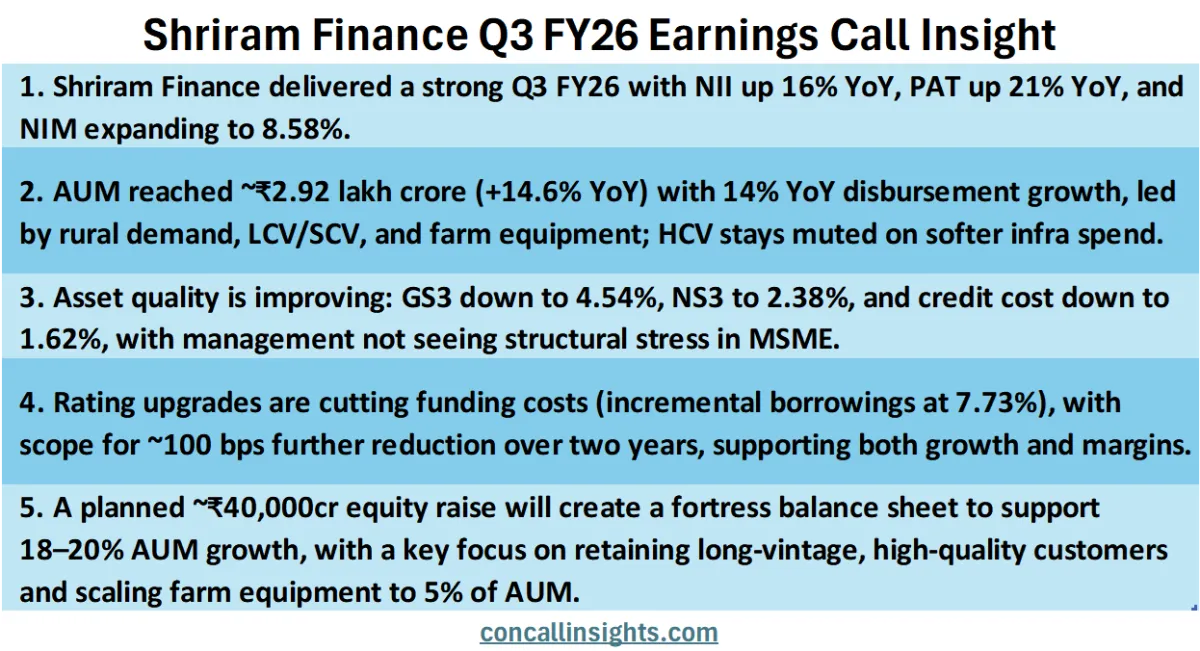
- Net Interest Income (NII): ₹6,764.09 crores, up 16.17% YoY.
- Profit After Tax (PAT): ₹2,521.67 crores, reflecting a 21.21% growth YoY (excluding one-offs from the housing finance stake sale).
- Earnings Per Share (EPS): Stood at ₹13.40, up from ₹11.07 in the previous year (adjusted).
- Net Interest Margin (NIM): Expanded to 8.58%, compared to 8.48% YoY and 8.19% sequentially.
- Return on Assets (RoA) / Return on Equity (RoE): The company expects these metrics to improve further as credit costs decline and leverage is optimized.
Key Highlights from Management Commentary
Mr. Umesh Revankar (Executive Vice Chairman) and Mr. Parag Sharma (MD & CEO) provided a detailed overview of the macro environment and company strategy.
Macro Outlook & Rural Demand
- Economic Tailwinds: Management highlighted India’s 8.2% GDP growth and controlled CPI inflation (1.33%) as positive signals for consumer spending.
- Rural Strength: The rural economy is performing well, with strong agricultural output driving credit demand in rural and semi-urban geographies.
- Auto Sector Boom: The GST rate cuts have helped the auto industry significantly. Commercial vehicle (CV) sales grew 21.5%, passenger vehicles (PV) grew 20.6%, and tractors saw a massive 28.8% jump in sales during the quarter.
- Infrastructure Lag: Government infrastructure spending was lower than expected, which impacted the construction equipment segment (sales down 14%). Management is hopeful the February 1st budget will reignite this sector.
Strategic Initiatives
- Customer Retention: The company plans to use its improved cost of funds to retain high-quality customers who typically migrate to banks after 6-8 years. By offering better rates, Shriram aims to keep them within the ecosystem.
- Farm Equipment Push: There is a specific focus on increasing the farm equipment book to 5% of total AUM, leveraging their deep rural presence.
- Digital & Branch Network: No major shift in asset mix is planned, but the branch network will be optimized to support gold lending growth.
AUM Growth & Disbursements
The company continues to demonstrate its ability to mobilize assets effectively, even on a large base.
- Assets Under Management (AUM): Reached ₹2,91,709 crores, growing 14.63% YoY and 3.7% quarter-on-quarter (QoQ).
- Disbursements: Totaled ₹48,645 crores for the quarter, a strong growth of 14.17% YoY.
- Growth Guidance: Management is confident of sustaining an AUM growth rate of 18-20% over the next few years, supported by the incoming capital infusion.
Segment Trends
- Commercial Vehicles (CV): This remains the core strength. While heavy CVs are slow due to infra pauses, Light Commercial Vehicles (LCV) and Small Commercial Vehicles (SCV) are seeing high traction due to last-mile delivery and rural demand.
- New vs. Used: New vehicles make up only about 10% of disbursements. The used vehicle market remains vibrant, although high prices of new trucks are preventing some operators from upgrading, leading them to hold onto older vehicles longer.
- Tractors & Farm: Disbursement growth here is outpacing other segments, driven by a good harvest season.
Asset Quality Analysis
Asset quality metrics showed a clear trend of improvement, reflecting better collection efficiencies and a healthy borrower profile.
- Gross Stage 3 (GS3): Improved to 4.54%, down from 5.38% a year ago and 4.57% in the previous quarter.
- Net Stage 3 (NS3): Stood at 2.38%, an improvement from 2.68% YoY.
- Credit Costs: Declined to 1.62% of total assets, compared to 1.85% in Q3 FY25. This 23 basis point reduction is a significant driver of profitability.
Management Commentary on Stress
- MSME “Stress”: Analysts noted a slight uptick in Stage 3 assets in the MSME and Personal Loan books. Management dismissed this as “uncertainty” rather than structural stress, attributed partly to temporary fears regarding US tariffs affecting export-oriented MSMEs (e.g., textiles, leather).
- Outlook: Management stated they do not see overcapacity in the CV market. Vehicle utilization is at a high of 21-25 days per month (vs. historical 19-22 days), which supports borrower cash flows and repayment ability.
Profitability Metrics
Shriram Finance delivered a “beat” on margins, largely due to efficient liability management.
- Net Interest Margin (NIM): Came in at 8.58%, expanding by 39 basis points sequentially.
- Drivers of NIM:
- Lower Cost of Funds: Borrowing costs are trending down due to rating upgrades.
- Pricing Power: The ability to pass on rates in the used vehicle segment.
- Outlook: The CFO, S. Sundar, guided that NIMs will be maintained at current levels, likely in the 8.5% to 9% range. The benefit of lower borrowing costs will be partially passed to customers to retain them, balancing margin expansion with volume growth.
Operating Expenses & Efficiency
While income grew, operating expenses saw a one-time bump this quarter.
- Cost-to-Income Ratio: Increased to 29.66%, up from 27.76% in the previous quarter.
- The Reason: The increase was primarily due to an incremental impact of roughly ₹197 crores related to gratuity and long-term compensation expenses (driven by definitions under the new labor code).
- Employee Costs: Apart from the one-off, employee expenses rose due to incentive payouts aligned with the festive season business volumes.
- Outlook: Management expects efficiency ratios to normalize as these one-offs recede and operating leverage from AUM growth kicks in.
Funding Mix & Liquidity
The liability side of the balance sheet is becoming a major strategic advantage for Shriram Finance.
- Cost of Borrowing: The total cost of liabilities on the book dropped by 14 basis points to 8.69%.
- Incremental Cost: Fresh borrowings are coming in much cheaper at 7.73%.
- Rating Upgrades:
- CARE: Upgraded rating.
- S&P: Upgraded to BBB-.
- Moody’s & Fitch: Placed on positive watch.
- Impact: Management expects borrowing costs to reduce by another 100 basis points over the next two years due to these upgrades.
- Liquidity: The company is sitting on high liquidity (LCR at 335%), maintaining a buffer of three months of liabilities.
Capital Adequacy & Balance Sheet Strength
The company is in a robust capital position, with a massive equity infusion on the horizon.
- Equity Raise: The company is preparing for an equity infusion of approximately ₹40,000 crores.
- Leverage Ratio: Currently at 4.05x, which is comfortable.
- Utilization of Cash: Addressing analyst concerns about the “cash drag” from such a large infusion, the CEO explained that with quarterly disbursements running at ₹45,000-50,000 crores, the fresh capital will be consumed efficiently.
- Tier 1 Capital: Post-raise, the Tier 1 ratio is expected to be very strong (analysts estimated in the 30s), positioning the balance sheet similarly to top-tier peers like Bajaj Finance.
Q&A Analysis
The Question and Answer session offered deeper insights into the company’s tactical shifts.
Q: How will you deploy the massive ₹40,000 crore cash infusion without hurting Return on Equity (RoE)?
- Analysis: This was a key concern from Chintan Joshi (Autonomous).
- Management Response: The cash won’t sit idle for long. The company disburses that amount in a single quarter. More importantly, they will use the strong capital base to aggressively retain “graduating” customers those with 6-8 year track records who usually leave for banks. Shriram will offer them bank-like rates to keep them.
Q: Why is the Heavy Commercial Vehicle (HCV) outlook cautious?
- Analysis: Piran Engineer (CLSA) noted the management’s lack of bullishness on HCVs.
- Management Response: HCV sales are tied directly to infrastructure projects (cement, steel). Since government infra spending slowed recently, HCV demand is muted. They expect single-digit growth here until the Budget potentially unlocks new spending.
Q: Is there stress in the MSME book?
- Analysis: Multiple analysts pointed out rising Stage 3 assets in MSME.
- Management Response: The CEO clarified this is not structural stress but “anxiousness” due to external factors like US tariffs impacting export-led MSMEs. Customers are diversifying markets, and Shriram does not expect these to turn into NPAs.
Q: How will you manage pricing risk when offering lower rates to good customers?
- Analysis: There is a risk of cannibalizing margins.
- Management Response: Pricing is based on an internal rating system, not just external credit scores. The benefit of lower credit costs from these high-quality customers (estimated at 10-20 bps benefit to the overall book) allows Shriram to offer lower rates while protecting margins.
Key Takeaways
- Rating Upgrade is a Game Changer: The upgrade to investment grade (international) and higher domestic ratings is structurally lowering Shriram’s cost of funds. This gives them ammunition to fight banks for high-quality customers.
- Rural is the Engine: While urban infrastructure is taking a breather, the rural economy (driven by tractors, LCVs, and two-wheelers) is firing on all cylinders. Shriram’s deep rural reach places it perfectly to capture this.
- Asset Quality Control: The consistent drop in Gross and Net Stage 3 assets proves that the merger integration is smooth and the underwriting model remains robust, even in a high-growth phase.
- Farm Equipment Pivot: Investors should watch the new target to grow the farm equipment book to 5% of AUM. This is a high-yield segment that complements their existing rural distribution.
- Capital Heavy: With the upcoming equity raise, Shriram will have a “fortress balance sheet.” The key challenge will be deploying this capital fast enough to prevent a drag on RoE, but management seems confident in their volume growth targets.

You must be logged in to post a comment.